

 NFL
NFL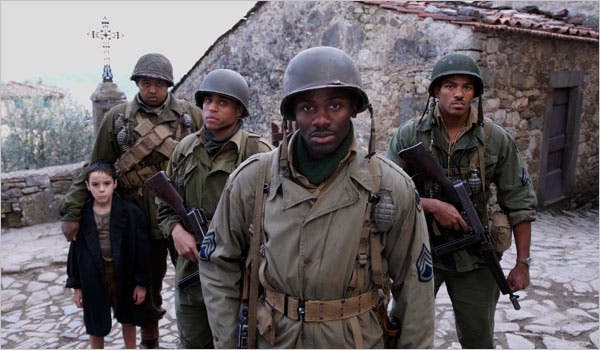
By: Matt Overton
The Eighteenth Joint
A mild-mannered postal worker murders an innocent man in cold blood one random morning, and an ancient Italian statue is found in the perp’s apartment. To answer why this gentle old man would commit such a crime or have a priceless artifact stuffed in a junk closet, the film Miracle at St. Anna must take us back to a small Italian village in 1944. Spike Lee’s first epic war film, released in 2008, tells the story of a troop of African American soldiers fighting fascism in Europe. Adapted from the historical nonfiction novel by James McBride, the two co-wrote the screenplay and turned it into a 160-minute drama.
The 92nd Infantry Division was staffed entirely by African American soldiers during World War II. They adopted the name Buffalo Soldiers from the Civil War era, carrying on the legacy of proud African American soldiers from the 19th century. The characters we follow in this film are especially from New York, though, because this is still a Spike Lee Joint. As interesting as a film would be about racial tensions and segregation during the Second World War, Miracle at St. Anna isn’t too interested in exploring those problems. Instead, this is a deeply religious film that depicts all the different combatants in this world war and how religion played a role in each of their lives.
The story centers around four Buffalo Soldiers: Staff Sergeant Stamps, Sergeant Cummings, Corporal Negron, and Private Train. The men are alongside the 92nd Infantry as they attempt to cross a crucial river somewhere in the Italian countryside. Why this specific river must be forged or its tactical importance is never divulged. The four are the only ones to make it across alive, even as their commanding officer, played by Walton Goggins, does everything in his power to hinder their efforts. This is where the film begins to tackle the structural racism in the U.S. military, but aside from a few hateful comments or arguments, the script doesn’t delve fully into those aspects of the war.
When Train finds a defenseless Italian boy hiding in a barn, he takes it on himself to become his protector. He just so happened to stumble upon a head from a marble bust that he carries with him everywhere, convinced it has magical powers that make him invincible. The men wander into a quaint town where the inhabitants have been living under the fascists’ thumb for three years, and they’ve given up all hope that anyone is coming to save them. They fall into trouble with the local partisans who are waging a guerrilla war against the occupying Germans. The narrative dips into some Italian and German stories throughout the extended runtime, but it’s mostly interested in the four men from New York.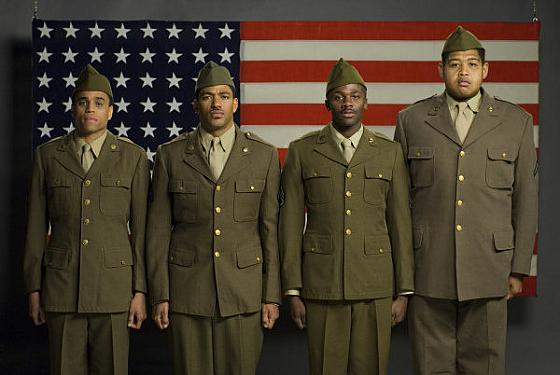
There are about two or three full-scale gunfights in the movie, which Spike directs with minimal flair. But this specific war flick cares less about violence than the quiet, reflective moments in between all the killing. Characters pray in English, German, Italian, and all maintain their faith throughout all the tribulations thrown at them. It’s an interesting perspective for the narrative to take, but not the most exciting for a war film, especially since everything that is explored is so surface-level.
Miracle at St. Anna is a very strange film when held up next to the rest of Spike’s filmography. It’s a very straightforward war movie, with all the usual stereotypes and cliches. His direction appeared quite uninspired and plain, as is the script by McBride. The picture never picks up any speed; instead, it slowly trudges through all 160 minutes. The vibe of this movie as a whole is like an unenthusiastic student reading from a textbook. The story is an interesting one, and the characters are explored well enough, but there’s no energy behind the filmmaking, so the production suffers.