
 NFL
NFL
By Bill Carroll
The phrase “ignorant armies battle in darkness” is a misquote of the famous closing lines of the poem, “Dover Beach,” a lyric poem by the English poet Matthew Arnold. First published in 1867 in the collection New Poems; however, scholars found surviving notes indicating its composition may have begun as early as 1849. The consensus completion date is considered to be 1851. The correct line reads:
“Where ignorant armies clash by night”.
The speaker’s pessimistic view of the modern world conjures the poem’s imagery. Part of this clash, which is being noted, is a conflict to reclaim a lost foundation of faith and moral certainty, or at least that is what I remember from Dr. Page R. Laws‘ lectures.
UCLA: On Offense
Why the poetic allusion? It seemed fitting to me as UCLA (0–3) heads to Evanston to face Northwestern (1–2) after a rocky start, the Bruins have scored just 43 total points (14.3 per game) while allowing 108 (36 per game), in losses to Utah, UNLV and New Mexico. Conversely, their offense is averaging ~324.7 yards per game [202.7 passing, 122 rushing] and have scored three touchdowns so far, with a 22.9% 3rd-down conversion rate.
Perhaps the most concise encapsulation of the Bruins offensive struggle is Nico Iamaleava. The former five-star prospect according to 247Sports and Rivals, four star according to ESPN, has seen some true highs, SEC Freshman of the Week four times, finalist for Polynesian College Football Player of the Year and helped Tennessee to its first CFB playoffs appearance.
And some low lows, versus Utah he was 11 for 22, with 1 touchdown, 1 interception, 136 yards passing and 47 yards rushing. Those are moribund numbers for an average NCAA QB, but for, reportedly, upwards of $1.2 million, per season, more is expected. Nevertheless he remains hopeful:
|
|
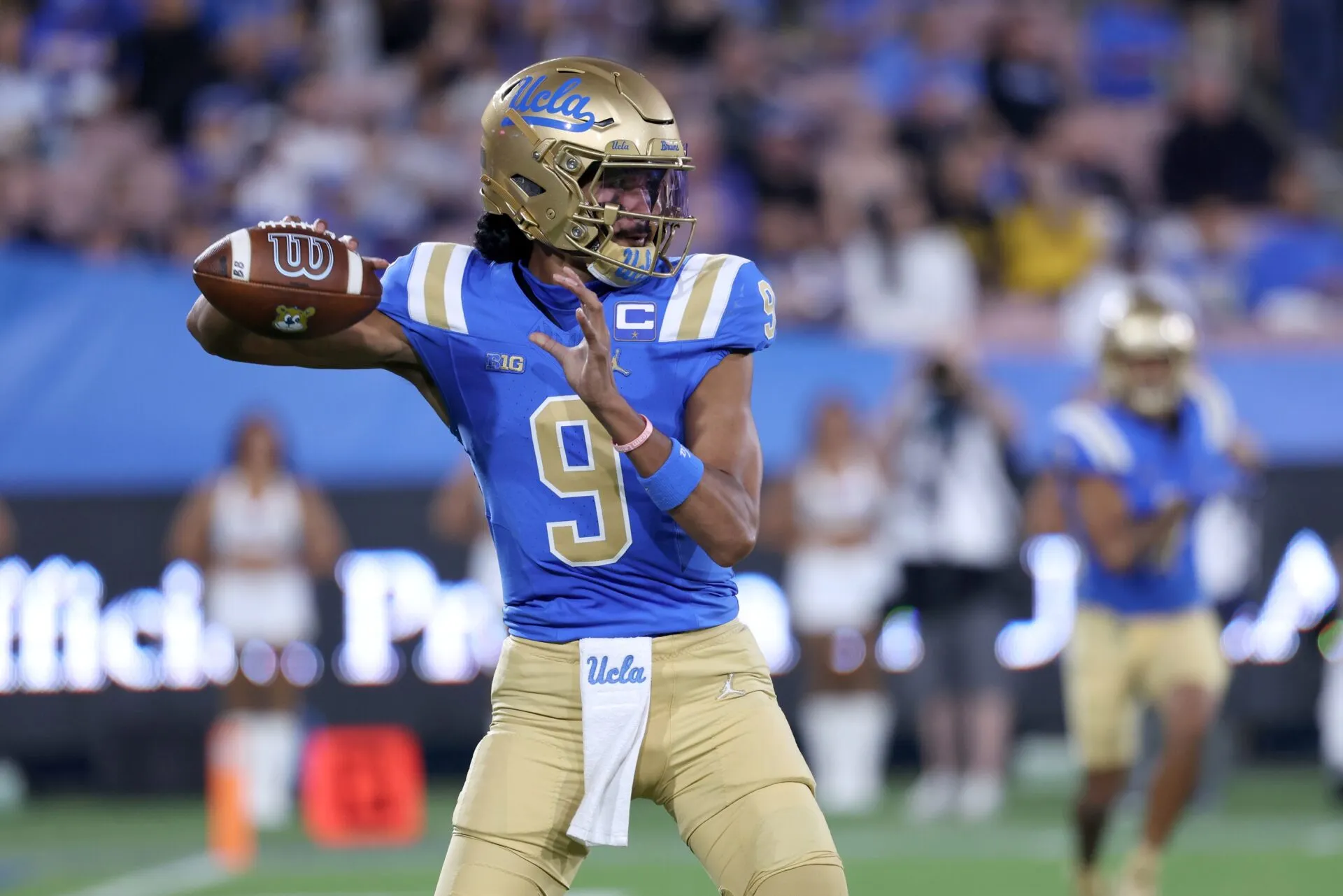
“Keep the belief. The season hasn’t gone how we wanted it to go but I still got faith in every one of the guys,” Iamaleava said. “We trust Coach Skip and what he has for us. I think just keep the belief that we have in each other.”
Northwestern: On Offense
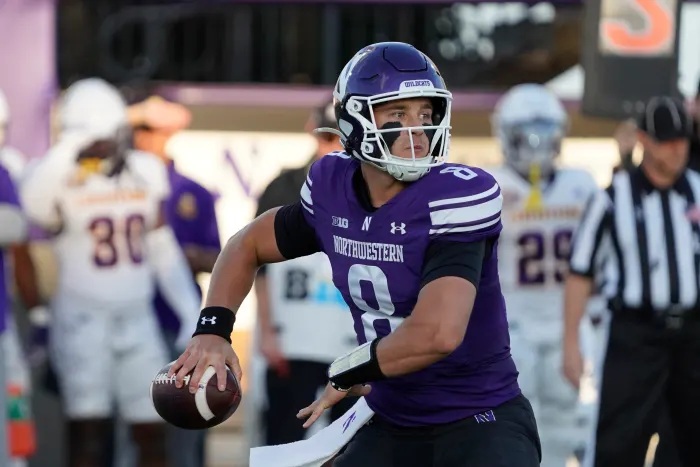
On offense the Wildcats are unspectacular, however they are at least functional. At 5.7 yards per play to UCLA’s 5.4. Northwestern’s balanced offense has totaled ~358.7 YPG (180.3 pass, 178.3 rush) and 59 points (19.7 PPG). Key contributors include RB Cam Porter (150 rush yards) and WR Griffin Wilde (213 receiving yards). The other issue is that the Wildcats have been turnover-prone (–6 turnover margin) and are adjusting to a new staff.
In my opinion the Northwestern game-plan should hearken back Woody Hayes of about 60 years ago. Run the ball until they prove they can stop it. Utah ran 54 times against UCLA and the New Mexico Lobos humbled the Bruins for 298 yards on the ground, in a game in which they averaged, a gaudy, 7.1 yards per play!
Northwestern was effective running the ball against Oregon, even without Dashun Reeder’s 79-yarder, which was very well blocked, Joseph Himon II and Caleb Komolafe challenged the Ducks as they each ran for over 50 yards (4.9 yards-per-carry for Himon, 3.3 or Komolafe). Throw the ball only when you absolutely must and pound the Bruin’s suspect interior.
UCLA: On Defense
In a word, “Yuck”. UCLA has struggled against the run 244 allowed on the ground and ranks near the bottom nationally in scoring defense. The UCLA Bruins defense is allowing opponents a 62.16% 3rd-down conversion rate against non-conference opponents, but has been a sieve versus ranked teams. I had to double-check when I saw they allowed a 82.35% 3rd-down conversion rate, to ranked teams.
UCLA allowed a 45% 3rd-down conversion rate against the two unranked teams they faced. While better than their virtual capitulation against ranked foes, still it is nothing to be celebrated.
The Chess Match: UCLA
Offensive and Defensive Schemes
UCLA’s new offense under OC Tino Sunseri resembles Indiana’s spread scheme. It’s fast-paced, RPO-heavy, leans on pre-snap motion and multiple tight ends to create favorable match-ups. UCLA often aligns in 11- or 12-personnel sets (2‑TEs, one RB) with the QB in shotgun, emphasizing quick reads and play-action.
The quote below from former Indiana QB Michael Penix serves to illustrate:
“Very fast-paced… it has RPOs and a great passing attack… pre-snap motion will be a staple”
🧠 “Levels” Concept – Shotgun, 11 Personnel
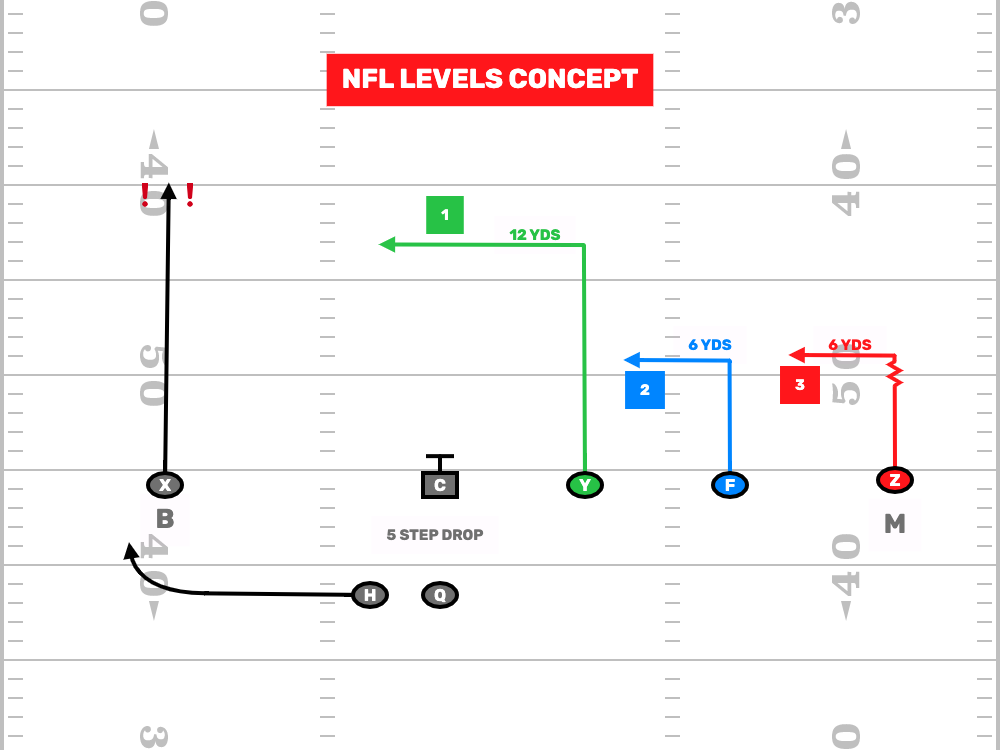
Formation: Shotgun, 11 personnel (1 RB, 1 TE, 3 WR) Purpose: Stretch zone coverage horizontally and vertically to create clear throwing lanes.
🔍 QB Read Progression
- Pre-Snap:
- Identify coverage shell (Cover 2, Cover 3, Man).
- Use motion to diagnose zone vs. man.
- Confirm safety depth and linebacker alignment.
- Post-Snap Progression:
- Primary Read: Deep dig route (WR X) – 12–15 yards across the middle.
- If the deep safety drops and the MLB vacates, this window opens.
- Secondary Read: Intermediate crossing route (WR Z or slot) – 8–10 yards.
- If the linebackers sink under the Dig, this becomes the check.
- Tertiary Read: Shallow drag or flat (TE Y or RB R) at 3–5 yards.
- If pressure arrives or zone defenders drop deep, hit the underneath route.
- Check-down: RB swing or TE leak is a safety valve if all else is covered.
- Primary Read: Deep dig route (WR X) – 12–15 yards across the middle.
🧩 Coaching Note
Sunseri’s version often uses motion to pull linebackers laterally before the snap, creating natural voids in zone coverage. The QB is trained to throw with anticipation, not reaction, especially against Cover 3. The issue is that Nicholaus Iamaleava Jr., does not consistently throw with anticipation.
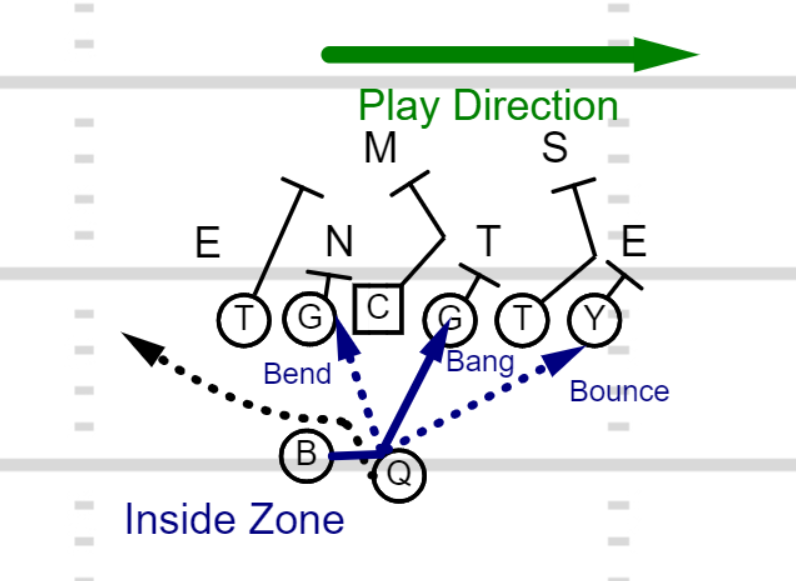
🛡️ “Inside Zone” – Shotgun, 11 Personnel
Formation: Shotgun, 11 personnel Purpose: Create vertical displacement in the defensive front and allow RB to choose the best gap based on flow.
🔧 Blocking Assignments
- Play Side OL (Right)
- RT & RG: Combo block on 3-technique DT → climb to strong-side linebacker.
- C: Reach block on nose or shade → seal off backside pursuit.
- Back Side OL (Left)
- LG & LT: Zone step → double team 1-technique or backside DE → climb to WILL.
- TE (Y): Base block on edge defender or chip and release to second level.
- WRs:
- X (Left WR): Crack block on safety or stalk corner.
- Z (Right WR): Push vertical to occupy CB or block nickel.
🏃 RB Path
- RB aligns offset to the QB’s left.
- At snap, he reads the first down lineman outside the center.
- If the defender flows outside → cut inside.
- If the defender crashes → bounce to the edge.
- The RB’s decision is based on leverage and flow, not a predetermined gap.
🧩 Coaching Notes
Sunseri emphasizes “pressing the line” before making a cut. The RB must sell the inside run to hold linebackers before bouncing. The OL is taught to block zones, not defenders, movement and angles matter more than brute force.
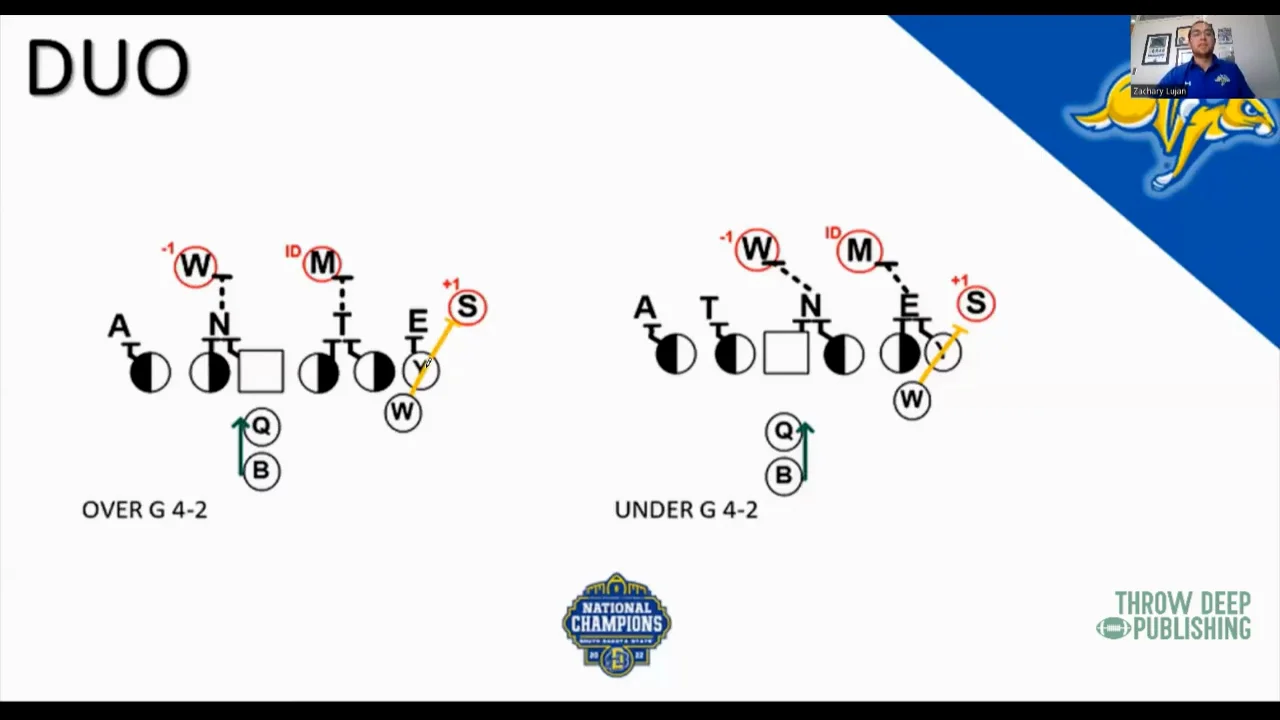
Zach Lujan’s scheme is RPO/motion-based spread. This scheme deploys heavy sets (60+% of plays in 12-13 personnel) and uses tight ends and fullbacks in multiple roles. This would be a great week to run his staple “Duo” series. Once the 8th defender is in the box, use quick attack soft cushions to flats, typically through out routes.
This Saturday the Wildcats get to be the bullies, the intimidating, physically imposing force. Taking what they want and taking no prisoners. Enjoy it!