

 NFL
NFL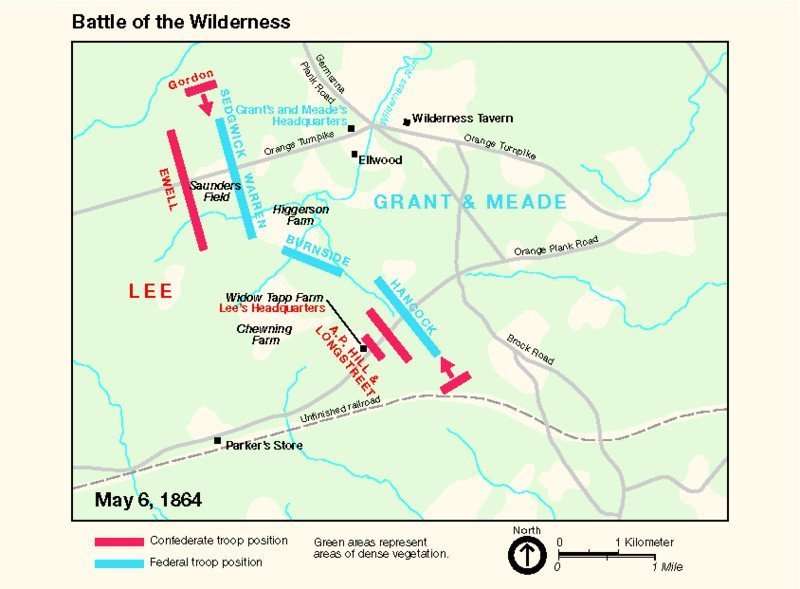
Northwestern Season Analysis
Northwestern closed the 2025 season 6–6 overall, 4–5 in the Big Ten, with a 20–13 loss to Illinois for the Land of Lincoln Trophy. The season is reminiscent of the five stages of the Wilderness Campaign, revealing a program that fought hard, absorbed steady pressure across a long schedule, but lacked a decisive turning point.
Tactical Draw
Season snapshot: Many Northwestern games were narrow, hotly contested affairs decided by turnovers, special teams swings, or late situational execution. The record reflects a team that rarely collapsed but also rarely dominated, locked in a string of tactical draws, leaving them with parity rather than momentum.
Key weaknesses exposed
- Late‑game turnovers and drive‑ending mistakes.
- Third‑down defense vulnerability, converting at roughly 46% for opponents.
- Inconsistent special teams that surrendered field position in critical moments.
Action items
- Ball‑security protocol: institute daily ball‑security drills emphasizing contact, two‑hand carries, and live‑tackling scenarios; track fumbles/turnovers per practice and set weekly reduction targets.
- Situational Drills: Scripted two‑minute and red‑zone sequences in every practice, rotate personnel to simulate fatigue and pressure.
- Special teams accountability: dedicate a practice per week to punt/return and kickoff coverage with measurable KPIs (average starting field position, return yards allowed).
Grant’s Overland Campaign
Season snapshot: The season was a continuous campaign of attrition against Big Ten opponents: incremental adjustments, small gains, and repeated tests of depth. Northwestern showed tactical discipline but lacked sustained offensive or defensive surges to turn a campaign into a decisive advance.
Key strengths and constraints
- Strength: disciplined defensive structure that limits scoring, 27th nationally in points allowed (≈19.5), showing the unit can hold in the red zone.
- Constraint: Offensive inconsistency and protection breakdowns prevented long drives and time‑of‑possession control.
Action items
- Offensive line development plan: implement a 12‑week technique and strength block focusing on hand placement, leverage, and communication; add film sessions isolating protection breakdowns by play type.
- Playbook simplification: streamline early‑down concepts to increase execution rate; prioritize high‑percentage plays that sustain drives and reduce three‑and‑outs.
- Depth mapping: create a readiness chart for every position, with next‑man‑up responsibilities and tailored repetitions for backups.
Wildcats’ War of Attrition
Season snapshot: Injuries, roster churn, and the cumulative effect of close games turned the season into a grind. The Wildcats often won the ugly battles but paid a price in wear, tear and missed opportunities. The Illinois finale, fittingly, was a low‑scoring, physical game, which helped underscore how attrition shapes outcomes.
Statistical signals
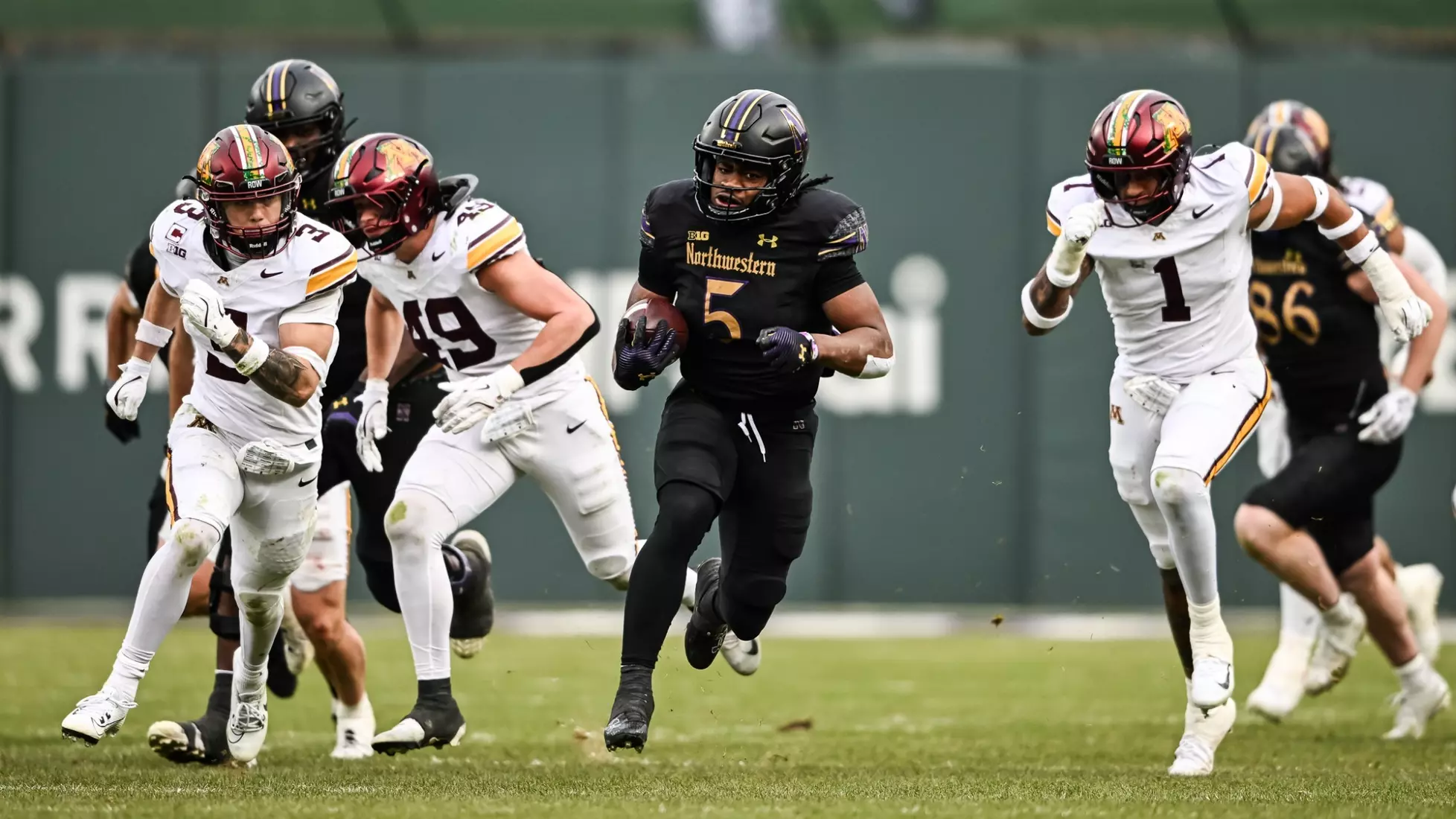
- Rushing production: Caleb Komolafe finished with 886 rushing yards, a clear offensive engine.

Photo via Mary Grace Graybill of Northwestern Athletics - Time of possession and finishing drives: Northwestern’s inability to consistently finish long drives translated to fewer scoring opportunities in tight games.
Action items
- Find a QB who impacts the other team’s game-plan: Whether a high school recruit or:
- Marcus Romain: A rising sophomore who enrolled early and was a newcomer to the quarterback room this season:
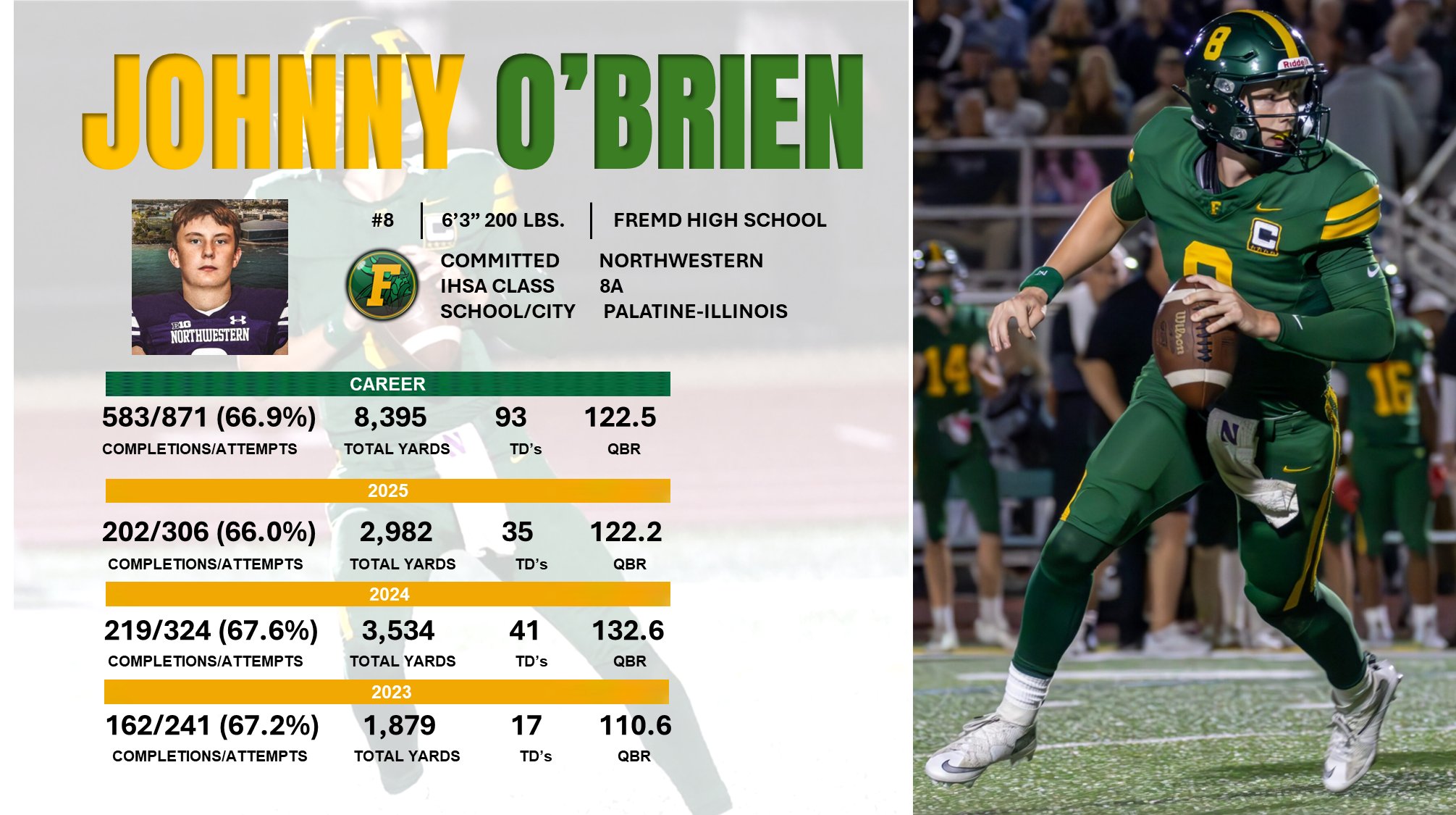
- Johnny O’Brien, a 6’2 ½” 196 quarterback from Fremd High School in Palatine, Illinois, is a 2026 Northwestern Wildcats commit known for arm strength and mobility. Last season, while also excelling as a two-sport athlete in baseball, he threw up 39 touchdown passes for 3,442 yards.

Graphic via his X Feed - Hit in the transfer portal:
-
- Aidan Glover: A rising redshirt-sophomore from Missouri Northwestern, heavily recruited out of high school. He would have three years of eligibility [due to a JC year] and possesses a strong arm and mobility.
- Conner Harrell: A redshirt-junior from North Carolina who had the Wildcats in his top three before committing to UNC, then transferring to Charlotte. He would have a year of eligibility remaining.
-
- Conditioning and recovery: expand in‑season recovery protocols (contrast baths, targeted mobility, individualized load management) and track player availability metrics.
- Rotation strategy: formalize rotational packages on both lines to preserve starters and give backups meaningful snaps before injuries.
- Recruiting and roster construction: prioritize multi‑year depth at offensive line and linebacker in recruiting cycles to reduce single‑season exposure.
Fierce Fighting
Season snapshot: Contests were often close affairs where the trenches and special teams decided the day. The Wildcats’ identity in these games was structure and toughness, but the same conditions magnified small errors into game‑deciding moments.
Strengths in close combat
- Red‑zone defense: ability to clamp down and force field goals or turnovers.
- Run game identity: methodical rushing attack, controlling pace, and wearing down opponents.
Weaknesses in close combat
- Third‑down defense and special teams lapses that flip field position.
- Passing game explosiveness: limited big‑play production when the run is contained.
Action items
- Third‑down packages: design and practice two new third‑down defensive packages tailored to opponent tendencies; install quick‑read keys for linebackers and safeties.
- Special teams drills under pressure: simulate crowd noise, wind, and short‑field punts; rehearse emergency punt and fake scenarios.
- Explosive play development: add vertical‑route windows and timing drills for QB‑WR pairs, creating chunk plays without abandoning the run.
Turning Point
Season snapshot: A true turning point, a signature win, or a clean multi‑game stretch never materialized, but was tantalizingly close. Grant’s determination in the Wilderness signaled a strategic shift; Northwestern needs a comparable inflection to move from resilience to ascendancy.
What would constitute a turning point
- A multi‑game winning streak against quality conference opponents.
- A marked reduction in turnovers and special teams’ errors over a 3–4 game span.
- A breakout performance from a skill‑position player that forces opponents to game‑plan differently.
Action items
- Quarterback development plan: create a targeted off-season program for the starting QB that emphasizes decision speed, pocket mechanics, and progressions under pressure; include measurable throwing accuracy targets. Build trust so that downfield passing can become a regular part of the offense. In the 2025 college football season. Preston Stone’s yards per pass attempt (YPA) with Northwestern was 6.41 yards! A YPA of 6.41 yards means he was approximately tied for 110th nationally among qualified FBS players. There are 136 Football Bowl Subdivision (FBS) teams.
- Identity reinforcement: codify a 15‑play scripted core offense that the team executes at 90% efficiency in practice; that can be the backbone for game plans, building confidence and consistency.
- Performance milestones: set team KPIs (turnover margin, third‑down defense percentage, red‑zone touchdown rate) and review them weekly; reward attainment with practice‑time incentives and recognition.
Statistical Synthesis Strengths, Weaknesses, and NFL Prospects
Season metrics and interpretation
- Record: 6–6 overall, 4–5 Big Ten, a middling finish masking competitive resilience.
- Defense: ~27th in points allowed (~19.5); 72nd in yards per play allowed (~5.6) which indicates bend‑but‑don’t‑break tendencies.
- Third‑down defense: ~46% conversion rate allowed, a clear area for improvement.
- Rushing leader: Caleb Komolafe, 886 yards, the team’s most consistent offensive weapon.
- Passing Leader: Preston Stone, 2,174 yards, 14 TDs, 12 INT, completing at 59.9%, 47 carries, 16 net yards, and a score.
- Receiving Leader: Griffin Wilde, 61 catches for 783 yards, 12.84 yards per catch, and 6 TDs.

Photo Via Ryan Kuttler of Northwestern Athletics Strengths
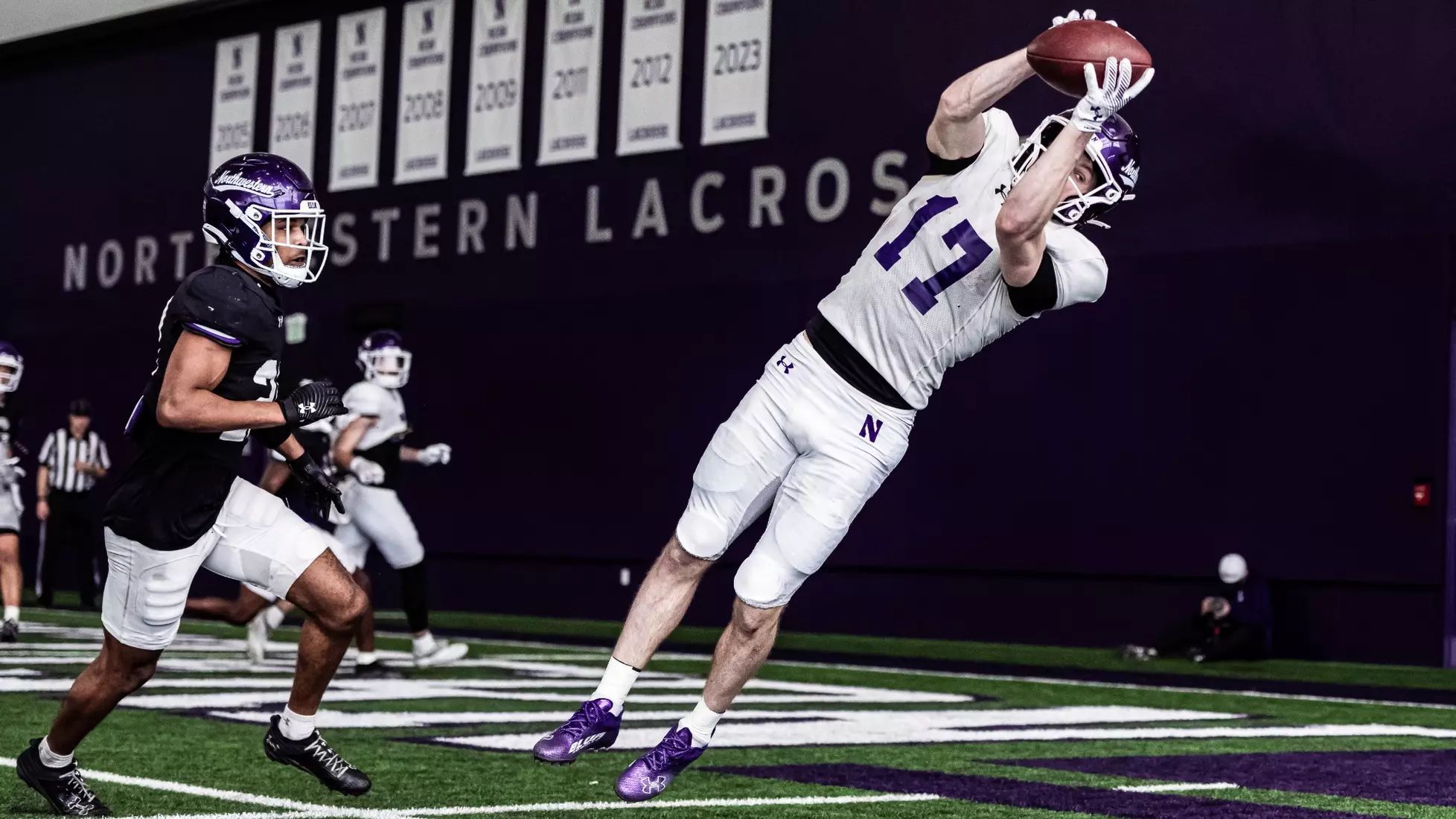
- Defensive discipline in the red zone and situational football.
- A workmanlike rushing attack that can control tempo when the line holds.
- Coaching adaptability in close games; the staff finds ways to keep contests competitive.
Weaknesses
- Turnover propensity in late moments.
- Third‑down defense and special teams inconsistencies that flip field position.
- Offensive line protection lapses that limit passing game development.
NFL prospects and player outlooks
- Caleb Komolafe led the Wildcats with 886 rushing yards. He projects as a player who will draw NFL interest for his production, contact balance, and short‑area vision; scouts will evaluate his pass protection and special teams value for the 2027 draft or undrafted free agent consideration.
- Preston Stone: his pro outlook hinges on decision‑making under pressure, accuracy on intermediate throws, and measurable traits; his all-star game performance will be critical to any NFL evaluation.
- Other prospects: Caleb Tiernan (OT): he has the highest pre-draft rating among the Northwestern players; he was a dual-sport athlete at Detroit Country Day, and captained both football and basketball.
- Anto Saka (DE): Considered one of the most impressive defensive talents in the country. He may be best served by staying in school to develop his skills. Some suggest a transfer could be beneficial to improve his production.
- Fred Davis II (CB): A 4-star recruit who has shown solid speed.
- Martes Lewis is a large and powerful offensive lineman with experience at OG and OT.
Concrete NFL prep action items
- Pro‑style drills: install weekly pro‑day routines for top prospects (route trees, blocking sets, coverage recognition).
- Film packages: create scout‑style highlight reels emphasizing situational excellence and versatility.
- Agent and combine readiness: coordinate with the strength staff to produce measurable testing plans and mock interviews.
Conclusion and After-Action Report
Northwestern’s 2025 season was a study in resilience: a team fighting every engagement but never seizing a decisive advantage. The Wilderness Campaign was similar, showing where the program must act, reducing turnovers, building depth, refining third‑down defense, and creating a clearer offensive identity. Priorities for the off-season:
- Ball security and situational execution (immediate).
- Offensive line technique and depth (12‑week program).
- Third‑down defensive packages and special teams overhaul (install before spring ball).
- Quarterback and skill‑position development with NFL prep for prospects (ongoing).
A disciplined, measurable approach that treats each practice as a tactical engagement will convert the season’s tactical draws into strategic victories next year.