

 NFL
NFL

By Bill Carroll
Tier 2: Pilots With First-Round Potential
Bill Carroll’s 2027 NFL Draft quarterback rankings | Continued
These quarterbacks possess starter-caliber traits and legitimate top-32 upside, but each must resolve a specific pressure, processing, or consistency concern before earning a first-round projection.
5. Gunner Stockton, Georgia
Fighter ace comparison: Walter Nowotny
Defining traits
Stockton is a compact, competitive operator whose toughness, mobility, and command raise both his floor and the offense around him. He plays with connected feet and eyes, finds leverage quickly, and delivers with anticipation when the structure holds.
The Nowotny comparison reflects operational speed. Stockton does not overwhelm opponents with one transcendent physical trait. He wins with rapid processing, selecting the correct answer, and maintaining control of the offense. We just watched Case Keenum excel with a similar skill set.
Analytical snapshot
| 38 of 45 passing (84.4%) | 583 yards; 13.0 yards per attempt |
| 9 touchdowns; 0 interceptions | 259.3 passer rating |
| No. 3 nationally in Total QBR |
NFL translation
Stockton projects as a rhythm-based starter who can run play-action, movement-pass, and timing concepts. His mobility adds designed-run and scramble value without requiring an offense to treat him as a run-first quarterback.
Stylistic range: Brock Purdy with elements of Case Keenum.
The catch
Stockton must prove that his command survives NFL-style disruption. The critical evaluation points are his efficiency against interior pressure, willingness to work beyond his first read, and ability to attack the boundary when defenses close the middle of the field.
Projected role
Rhythm-based NFL starter with a strong developmental floor and late first-round upside.

6. C.J. Carr*, Notre Dame
Fighter ace comparison: Thomas B. McGuire Jr.
Defining traits
Carr is a methodical, anticipatory passer with advanced timing for his experience level. He throws receivers open, layers the football over underneath defenders, and consistently matches trajectory to route depth.
The McGuire comparison reflects Carr’s rapid ascent. Like McGuire after his developmental posting in the Aleutian Islands, Carr has turned an early learning period into accelerated, high-level performance. His pre-snap recognition is already impressive, while his eye discipline and shoulder manipulation help create windows after the snap.
Analytical snapshot
| 53 of 73 passing (72.6%) | 726 yards; 9.9 yards per attempt |
| 6 touchdowns; 0 interceptions | 183.3 passer rating |
| No. 5 nationally in Total QBR |
NFL translation
Carr fits naturally in a timing-based West Coast system built around anticipation, intermediate-window throws, and layered play-action concepts. His touch and processing give him answers against zone coverage, while his eye manipulation creates opportunities against pattern-matching defenses. I see a Baker Mayfield ceiling.
The catch
Interior pressure disconnects Carr’s lower body from his throwing sequence and occasionally degrades his mechanics. He must move faster and more consistently off his primary read, rather than waiting for the initial concept to develop.
Projected role
Potential first-round starter in 2027 or 2028, ideally in a timing-based West Coast offense.
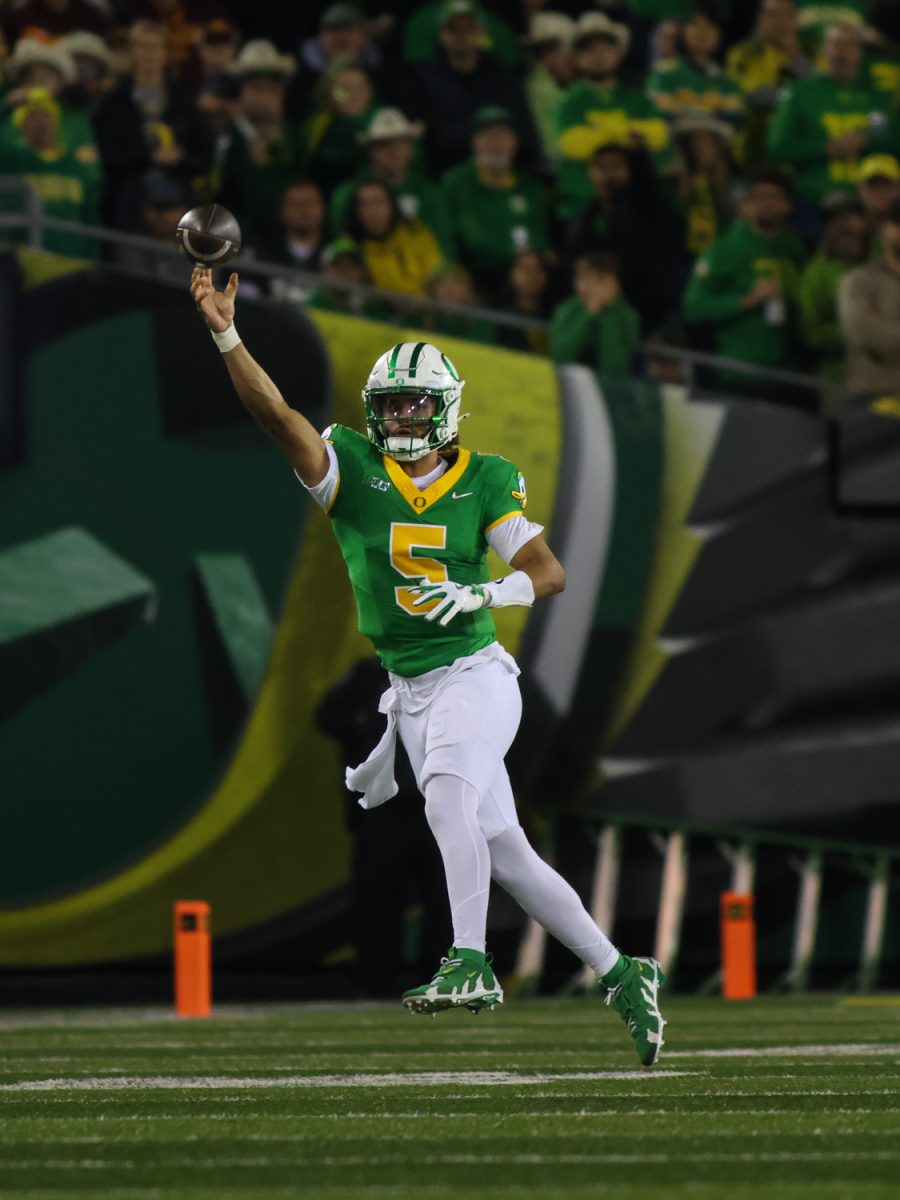
7. Dante Moore*, Oregon
Fighter ace comparison: Wilhelm Batz
Defining traits
Moore’s cleMoore’sing mechanics are noteworthy. His release is compact; the football exits with effortless velocity; he alters pace and trajectory without changing his throwing mechanics. The Batz comparison represents repeatability. Moore’s strength is not simply that he can make difficult throws. It is his ability to make them look routine through consistent mechanics, balanced platforms, and precise ball placement.
Analytical snapshot
| 61 of 89 passing (68.5%) | 849 yards; 9.5 yards per attempt |
| 9 touchdowns; 0 interceptions | 182.0 passer rating |
| 2025: 3,565 yards, 30 touchdowns, 71.8% |
NFL translation
Moore projects as a full-field passer in a timing, play-action, or West Coast structure. He has the arm elasticity to attack outside the numbers, layer throws between defenders, and punish aggressive safeties vertically. Think of a more talented version of Josh Johnson or Daniel Jones.
The catch
His Total QBR lags behind his passing efficiency, showing the need for better pressure management and consistent down-to-down value. Moore must avoid letting interior disruption accelerate the clock, flatten his base, or force premature check-downs.
Projected role
Potential first-round starter with the passing foundation to operate a complete NFL offense.

8. Sam Leavitt, LSU
Fighter ace comparison: Erich Rudorffer
Defining traits
Leavitt is an aggressive creator with the arm talent and improvisational spirit to turn broken plays into explosives. He attacks tight windows, escapes containment, and forces defenses to defend the entire length and width of the field after the initial structure breaks down. The Rudorffer comparison reflects sudden-strike capability. Leavitt produces high-impact plays in rapid succession; he can change a game before the defense can adjust.
Analytical snapshot
| 74 of 116 passing (63.8%) | 1,044 yards; 9.0 yards per attempt |
| 5 touchdowns; 6 interceptions | 79.6 Total QBR |
| 220 rushing yards and 6 rushing touchdowns |
NFL translation
Leavitt projects as a movement-based starter who can threaten defenses through designed quarterback runs, boot-action concepts, pocket escapes, and aggressive intermediate throws. His athleticism gives him access to solutions unavailable to less mobile passers. I am reminded of Daryle Lamonica and Dan Pastorini.
The catch
Leavitt must learn to throttle down. His creation instinct can become chaotic, turning manageable situations into unnecessarily risky plays. He needs to be more turnover-conscious, take check-downs, and distinguish between genuine explosive opportunities and plays that are DOA.
Projected role
Athletic developmental starter with explosive-play upside, but less developed than the quarterbacks ranked above him.

Athletics’estemaker*, Oklahoma State
Fighter ace comparison: Oskar-Heinz “Pritzl” Bär
Defining traits
M”stemaker’s appeal begiMestemaker’stability. His developmental path has not followed a conventional blue-chip trajectory, but he has consistently shown the ability to absorb coaching, adjust to new circumstances, and convert opportunity into production.
The Bär comparison reflects tactical versatility. Mestemaker can operate underneath rhythm concepts, challenge vertically, and create outside structure. He does not require every snap to unfold as planned.
Analytical snapshot
| 95 of 141 passing (67.4%) | 1,271 yards; 9.0 yards per attempt |
| 11 touchdowns; 5 interceptions | 161.7 passer rating |
| 106 rushing yards and 1 touchdown |
NFL translation
Mestemaker projects as a vertical-spread quarterback with enough mobility and improvisational skill to function outside pristine structure. More starts could produce a meaningful rise in both processing speed and draft value. In him I see Nick Foles.
The catch
The evaluation still needs a larger sample against NFL-caliber pressure and disguised coverage. His five interceptions represent a 3.5 percent interception rate, which is high for a projected first-round quarterback. He must generate explosives without creating turnovers.
Projected role
Ascending starter candidate whose developmental trajectory matters more than his grade now.
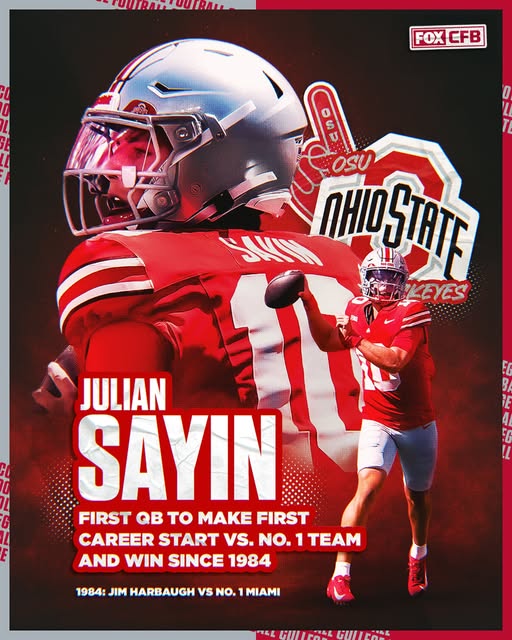
10. FOX’s Sayin*, Ohio State
Fighter ace comparison: Hermann Graf
Defining traits
Sayin is the class’s precision operatclass’s game is built around accuracy, rhythm, and mechanical economy. He consistently delivers from a stable platform, keeps the offense on schedule, and distributes the football without introducing unnecessary movement into his process. The Graf comparison reflects controlled technical production. Sayin wins by repeatedly executing the correct maneuver until the defense loses leverage, discipline, or both. I see elements of Ken Anderson and Derek Dallas Carr in his game.
Analytical snapshot
| 56 of 79 passing (70.9%) | 839 yards; 10.6 yards per attempt |
| 6 touchdowns; 1 interception | 182.6 passer rating |
| 2025: 77.0%, 3,610 yards, 32 touchdowns |
NFL translation
Sayin projects as a high-floor distributor in a structured offense featuring option routes, quick-game concepts, play action, and defined intermediate reads. His timing and placement should allow him to maximize NFL-caliber route runners.
The catch
He must prove that he can create space rather than exploit space created by structure and supporting talent. Scouts must evaluate his pressure response, ability to reset outside the pocket, and ability to drive the ball when his platform is altered.
Projected role
High-floor NFL starter with first-round potential in a structured, timing-oriented offense.
Part III is next in my “Pocket Aces” Series, “nd things get weird as we talk projects.