
 NFL
NFL
By Bill Carroll
My good friend who is a veteran and a rabid Bears fan, so much so that his prosthetic leg is emblazoned with Bears images. He tends to call me at work and ask me questions about the Bears coaching, defense, offense, personnel and schemes. So, I decided to answer some of his questions in the form of an article.
🧭 Ben Johnson’s Schematic Goals
Ben Johnson’s offense seeks to do two things: manipulate space and punish hesitation. He does not just want yards; instead, he wants defenders to question their career choices. The scheme prioritizes pre-snap motion, layered route concepts, and formation versatility to create mismatches and force defensive communication errors. It is not about trick plays; it is about tricking players.
Johnson’s goal is to make every snap a test of defensive discipline. The safety now must choose between biting on eye candy or staying deep. Linebackers must diagnose whether the motion is window dressing or a trap. And the corners are often on an island, praying for their help to arrive before the ball does.
📚 Ben Johnson’s Schematic Influences
Ben Johnson’s playbook is like a Frankenstein’s monster stitched together from the NFL’s most sadistic minds. There’s Sean McVay’s motion, Kyle/Mike Shanahan’s run-game geometry, and Andy Reid’s vertical spacing. But Johnson adds his own twist: a ruthless commitment to sequencing. He does not just call plays, he sets traps.
His background in mathematics and engineering shows. Routes are timed like clockwork, spacing is calculated, and play design feels like it is built to the finely calibrated tolerances of a Swiss timepiece. He’s not reinventing the wheel; he’s covering it in napalm.
💪 Ben Johnson’s Schematic Strengths
- Route Layering: Johnson stacks routes at multiple depths, forcing defenders to choose between covering the Flat, Quick Out, the Hook, Dig, Curl, or the Fade, Go, and/or Post. Spoiler: they usually choose wrong.
- Motion as a Weapon: Pre-snap shifts are not just for show; they are precision diagnostic tools. Johnson uses motion to identify coverage, bait blitzes, and reposition defenders.
- QB-Friendly Reads: His schemes often isolate a single defender, giving the quarterback a binary decision. If the linebacker steps up, throw behind him. If he drops, run underneath.
- Red Zone Efficiency: Johnson’s red zone packages are tight, creative, and brutal. He uses condensed formations to create rubs and leverage, turning tight spaces into scoring zones.
🧨 Ben Johnson’s Schematic Weaknesses
- Protection Complexity: The scheme’s reliance on deep drops and layered routes demands elite pass protection. When the offensive line falters, the whole thing collapses like a house of cards in a wind tunnel.
- Predictable Tendencies: Johnson’s sequencing can become a double-edged sword. Smart defensive coordinators (read: the ones who don’t wear visors indoors) can anticipate his setups and jump routes.
- Limited QB Mobility Integration: While the scheme is QB-friendly in terms of reads, it doesn’t fully exploit mobile quarterbacks. There’s room for more designed runs and boot-action to punish aggressive fronts.
- Option Routes and Progressions Take Time: Mastering option routes and full field read progressions requires immense repetition. Receivers must make leverage-based decisions on every snap, while quarterbacks must identify coverage rotations post-snap and work through progression reads. In complex systems like Ben Johnson’s, motion and misdirection add layers, requiring synchronized awareness between QB and skill players. This shared field vision only comes with thousands of live reps, ensuring timing, spacing discipline, and trust align under game pressure.
- Over-reliance on Timing: If the timing is disrupted, either by press coverage, interior pressure, or a QB with the processing speed of a dot-matrix printer, the offense sputters.
🎬 Ben Johnson’s Scheme: Examples Illustrated
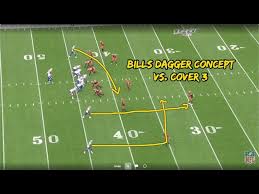
- “Dagger” Concept versus Cover 3
 Johnson runs a vertical clear-out with a deep dig underneath. The safety is pulled deep, the linebacker is frozen by a Shallow Drag, and the Dig opens like a trapdoor. It’s not magic, it’s math.
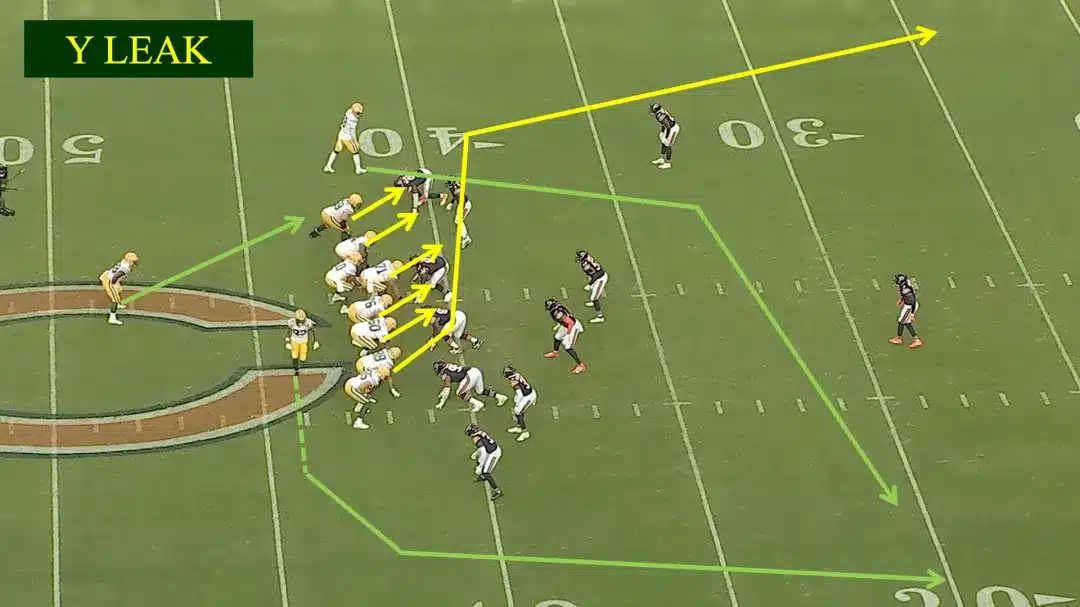
- “Y-Leak” off Play-Action

Picture Via Acme Packing Company The tight end fakes a block, then leaks into the flat behind the linebackers. The defense bites on the run, the QB rolls out, and the TE is alone with nothing but green grass and existential dread.
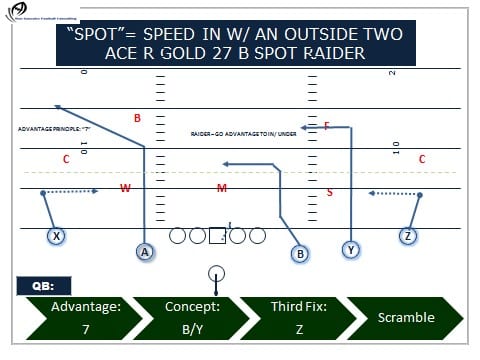
- “Levels” versus Zone Coverage

Image Via Dan Gonzalez Football Consulting Three receivers run routes at staggered depths across the field. The QB reads low-to-high. If the zone defenders sink, hit the shallow. If they bite, go deep. It’s a slow bleed, death by a thousand completions.
- “Orbit Motion Jet Sweep” Johnson uses orbit motion to pull the defense laterally, then runs a jet sweep behind it. The result? A horizontal stretch that turns pursuit angles into geometry problems defenders can’t solve.
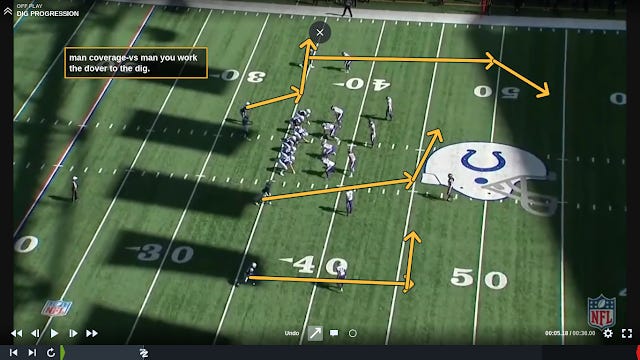
- “The Dover Route”

Via YouTube Johnson uses this route where a receiver runs a deep crossing route, often breaking at 10-12 yards or more, and cutting back towards the middle of the field after an initial outside move or slant. It’s also known as a “Y-Cross” and is used in concepts like “Shadow” or “Scissors” to create high-low reads against zone coverage by drawing linebackers to a shorter route while the Dover route attacks the space behind them. This attacks defenses by creating two routes that “scissor” or intersect in the middle of the field, forcing defenders to make difficult choices between a vertical (high) route and a deeper crossing (low) route, which often leads to separation and explosive plays.
Why Ben Johnson Uses Dover
Exploits Zone Coverage:
- Against zone defenses, the Dover route is designed to get behind the linebackers and find open space.
It Create Space:
- By drawing the safety or the linebackers out of position, the Dover route can open up other options on the field for the quarterback.
And Gives Options:
- It provides a clear read for the quarterback, offering a direct option against different defensive looks and situations, making it valuable on third downs.
- Is a threat when the offense establishes the run and the linebackers and safeties draw close so big plays develop behind them.
I started this article with an audience of one. If there is a demand, I will continue with a deeper dive.