

 NFL
NFL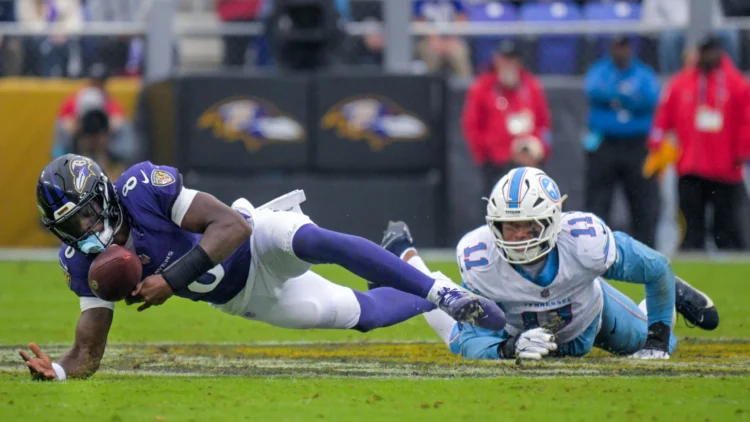
By: Courtney Byrd
BALTIMORE — For one half on Sunday, the Baltimore Ravens looked like the team they expected to be.
Lamar Jackson was moving the offense, Zay Flowers was creating explosive plays, and Baltimore had built a 24-7 halftime lead over the Tennessee Titans. Jackson completed 15 of 20 passes for 222 yards and two touchdowns, while Flowers caught six passes for 119 yards and a score.
Then Jackson injured his ankle.
The Ravens still walked out of M&T Bank Stadium with a 24-18 victory, but what happened after their quarterback left should matter more than the final score. Baltimore did not score another point; its offense became noticeably more conservative, and a game that appeared headed toward a comfortable victory turned into one the Ravens had to protect until the final minute.
Now, with Jackson considered day-to-day and his status for Week 5 uncertain, Baltimore has a much bigger concern than how close Tennessee came to winning Sunday’s game.
The Ravens got a glimpse of what their offense looks like without No. 8.
It was not particularly reassuring.
Jackson suffered the injury on Baltimore’s final offensive play of the first half when Titans defensive end Jermaine Johnson brought him down from behind. Jackson initially remained on the sideline before heading to the locker room and did not return.
Head coach Jesse Minter said Monday that Jackson is considered day-to-day. While Minter indicated he does not believe the injury will be a long-term issue, he did not commit to Jackson being available for Baltimore’s Week 5 matchup.
That leaves the Ravens preparing for a week in which the health of their quarterback will overshadow nearly everything else.
Tyler Huntley took over in the second half and was efficient, completing eight of nine passes for 63 yards while adding 16 yards on the ground. But those numbers do not tell the entire story.
Baltimore’s offense stalled.
The Ravens opened the second half with four consecutive punts and later came away empty when Tyler Loop missed a 40-yard field goal. After scoring 24 points with Jackson running the offense in the first half, Baltimore scored zero with Huntley in the second.
That contrast is difficult to ignore.
Huntley has experience in Baltimore’s system and has proven capable of stepping in when needed. But replacing Jackson has never simply been about finding another quarterback who can complete passes.
Jackson changes what defenses are allowed to do.
His ability to extend plays, escape pressure, and threaten defenses with both his arm and legs creates opportunities that disappear when he leaves the field. Baltimore’s offense can operate without him, but Sunday showed just how quickly it can become less dangerous.
That becomes even more concerning because Jackson’s injury did not happen in isolation.
Baltimore is already dealing with instability along the offensive line, including uncertainty at center. Andrew Vorhees left Sunday’s game with a foot injury, while the Ravens have already been forced to shuffle pieces up front throughout the early portion of the season.
The penalties are making matters worse.
Baltimore was flagged 13 times for 131 yards against Tennessee. Those are self-inflicted mistakes that become much harder to overcome when the offense is missing the player most capable of erasing them.
With Jackson on the field, a holding penalty or stalled play can sometimes be followed by something extraordinary.
Without him, Baltimore’s margin for error becomes considerably smaller.
That was evident Sunday.
The Ravens needed their defense to protect what the offense had built before halftime, and this time, that unit delivered.
Trenton Simpson intercepted Cam Ward on Tennessee’s second offensive play, giving Baltimore excellent field position and helping the Ravens establish control early. Nnamdi Madubuike helped stop Tony Pollard on fourth-and-goal later in the first half, while Baltimore’s defense forced three consecutive three-and-outs after halftime.
Kyle Hamilton finished with six tackles, a tackle for loss, a forced fumble, and a pass breakup. Rookie Ethan Burke also recorded the first sack of his NFL career.
Those plays became even more important once Jackson was gone.
Tennessee eventually cut Baltimore’s lead to six after a late touchdown and two-point conversion, but the Ravens recovered the ensuing onside kick to secure the victory.
It was enough to win on Sunday.
Whether that formula is sustainable is a different question.
Baltimore’s Problems Become Bigger Without Jackson
Jackson understandably dominates the conversation, but Baltimore’s injury situation extends beyond its quarterback.
Marlon Humphrey left Sunday’s game with a calf injury. Vorhees suffered a foot injury, and tight end Durham Smythe exited with an Achilles injury. The Ravens entered the afternoon already managing injuries elsewhere on the roster.
Every NFL team deals with injuries, but Baltimore is simultaneously trying to establish consistency under a new coaching staff, stabilize an offensive line, and eliminate penalties that continue to cost the team yards.
Losing Jackson for any amount of time would magnify each of those issues.
The Ravens do have reasons for optimism.
Flowers looked explosive again Sunday, and his connection with Jackson was one of the biggest reasons Baltimore controlled the first half. Loop showed off his range by connecting on a 64-yard field goal. The defense responded when Baltimore suddenly needed it to carry the second half.
Most importantly, Minter indicated Monday that he does not expect Jackson’s ankle injury to be a long-term issue.
But not long-term and ready for Week 5 are two different things.
Baltimore still does not know whether Jackson will be available for its next game, and that uncertainty will hang over everything the Ravens do this week.
The larger concern is what Sunday’s second half revealed.
Baltimore spent the first 30 minutes looking explosive offensively. Jackson averaged more than 11 yards per pass attempt, Flowers had already crossed 100 receiving yards, and the Ravens put 24 points on the board.
Then Jackson disappeared from the offense, and so did the points.
That does not mean Huntley cannot win games if he is asked to start. It means the Ravens cannot expect him, or anyone else, to cover up the other problems that Jackson routinely helps them overcome.
The penalties must decrease. The offensive line must become more stable. Baltimore’s defense must continue producing performances like Sunday’s second half.
Those things matter even if Jackson returns immediately.
They become essential if he does not.
That is the real concern Baltimore carries out of its win over Tennessee.
The Ravens got the result they needed, and the defense showed it could protect a lead when the offense suddenly stopped producing. But Baltimore also saw how quickly the complexion of a game can change when Jackson is no longer the player controlling it.
The focus now shifts to his ankle and whether he can get back on the field quickly. His status will matter, but Sunday’s lesson should remain even after he returns.
Baltimore cannot continue relying on Jackson to erase penalties, overcome instability, and create something when the offense breaks down.
The Ravens spent the first half showing how dangerous they can be with their quarterback.
The second half showed how much harder everything becomes without him.