

 NFL
NFL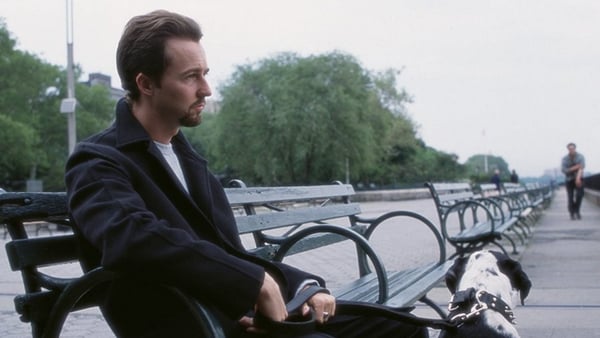
By: Matt Overton
The Fourteenth Joint
Before he helped create one of the worst seasons in television history, David Benioff wrote his debut novel titled “The 25th Hour.” The narrative is about a man named Monty who is convicted of drug possession as it follows him on his last night of freedom. The Spike Lee film 25th Hour, adapted by Benioff into a screenplay, adds a layer of post-9/11 trauma with Edward Norton stepping into the role of Monty Brogan. Released in 2002, this film could be viewed as a kind of therapy for the writer and director, as Monty wanders the streets of New York City in a befuddled daze, coming to terms with the sum of his life choices.
The film opens with the sounds of a dog being abused, followed by the revving of a loud muscle car. Monty is seen riding with his co-conspirator Kostya. His Ukrainian counterpart is tired of the Americans’ cowboy habits, and rescuing this beaten, abandoned dog lines up with some other reckless decisions. But the dog that would be named Doyle becomes Monty’s true ride or die, and the two are inseparable for the rest of the film. At first, Monty is casually sauntering the streets, visiting the local sights before making it home to his loving girlfriend, played by Rosario Dawson. They’re rudely interrupted by a trio of DEA agents led by Isiah Whitlock Jr. Sheeeeit is exactly what Monty was thinking too.
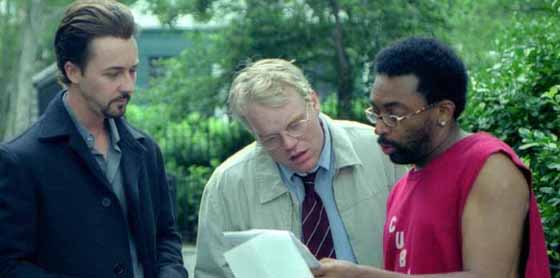
After being ensnared by the DEA, Monty must accept his new reality, so he gets some of his closest friends—and his drug overlord—together for one last party. Phillip Seymour Hoffman is a high school teacher named Jacob Elinsky, and Barry Pepper plays the stockbroker Frank Slaughtery. We’re introduced to Mr. Elinsky first when Monty drops in mid-Socrates circle to extend the invite, and there’s something weird going on with a student played by Anna Paquin. Slaughtery is busy at work, betting the unemployment numbers will be lower than expected while his boss is breathing down his neck. Al Palagonia is seemingly in every Spike joint, and he’s becoming one of my favorite actors to spot. He can always be counted on to spew some thick Italian jargon while motioning around with his meaty paws, especially when he gets heated.
25th Hour seems to be interested in exploring masculinity and the way it influences friendships and decision-making. There’s a stylized monologue that Monty delivers to himself in a mirror that encapsulates a lot of the film’s themes. He rages against the city of New York and its denizens of all backgrounds. It’s a toxic, racist tangent that his reflection delivers in a fury, before Monty regains control of his subconscious and maturely accepts responsibility for his actions. In his shock, Monty is searching for a scapegoat, but comes to realize the Korean grocers, neighborhood ballers, stock market agents, etc., are not responsible for the consequences of his decisions.
The 9/11 angle to this story was not present in the novel, and it comes across as somewhat shallow in the film. It’s a nice touch considering the time this was released, but it’s very obviously an addition less than it is necessary to the narrative. The most poignant points are made in the climax, which is when it is most emotionally satisfying. The subplot with Elinsky’s student is the strangest part of the movie, but I can see the idea behind all of these men making ruinous decisions. I could’ve gone for more of the Slaughtery character; he brought most of the toxicity, and his wild card attitude added a lot of energy to the character’s dynamics.
Almost twenty-five years have passed since 9/11, and it’s hard to gauge how well America has processed the events. This film offers some interesting thought experiments in the immediate aftermath: how much has NYC changed and how much has stayed the same? Are New Yorkers traumatized, or do they just need an escape like always? People are still clubbing, still flirting, making love, but how many of them still have traumatic thoughts about terrorism? 25th Hour is an interesting slice of Spike’s filmography—a thoroughly New York film all the way through, it interrogates interesting ideas related to masculinity, the bonds we share with the friends we choose, and how differently we can react to consequences.